
phaflangers.lib
Phasers and Flangers library. Its official prefix is pf.
This library provides a set of phaser and flanger effects based on delay-line modulation.
The Phaflangers library is organized into 1 section:
References
Functions Reference
(pf.)flanger_mono
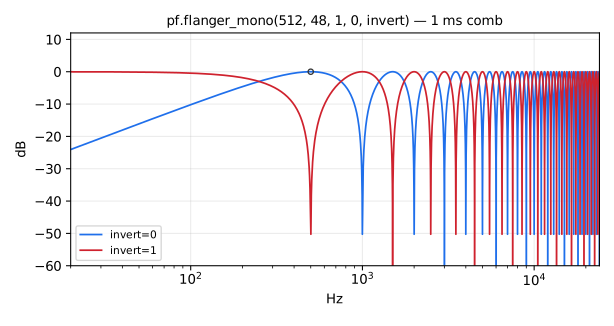
Mono flanging effect.
Usage:
_ : flanger_mono(dmax,curdel,depth,fb,invert) : _
Where:
dmax: maximum delay-line length (power of 2) - 10 ms typicalcurdel: current dynamic delay in samples, between 1 and dmax (values below 1 act as 1)depth: effect strength between 0 and 1 (1 typical)fb: feedback gain between 0 and 1 (0 typical)invert: 0 for normal, 1 to invert sign of flanging sum
The output is 0.5*(x + depth*v[n-curdel]) (minus with invert=1),
where v[n] = x[n] + fb*v[n-curdel]: the feedback loop and the
feedforward path have the same delay, so the feedback reinforces the
comb peaks at every frequency.
Test
pf = library("phaflangers.lib");
os = library("oscillators.lib");
ba = library("basics.lib");
ma = library("maths.lib");
no = library("noises.lib");
flanger_mono_test = os.tosc(440) : pf.flanger_mono(4096, 1024, 0.7, 0.25, 0);
flanger_mono_impulse_test = (1-1') : pf.flanger_mono(64, 5, 1, 0.5, 0);
flanger_mono_slider_test = os.tosc(440) : pf.flanger_mono(4096, hslider("flanger_mono:curdel", 1024, 1, 4095, 1), hslider("flanger_mono:depth", 0.7, 0, 1, 0.01), hslider("flanger_mono:fb", 0.25, 0, 0.99, 0.01), 0);
flanger_mono_modulated_test = no.noise : pf.flanger_mono(512, 1 + 255*tri, 1, 0.7, 0) with { P = int(ma.SR/10); tri = 1 - abs(2*ba.period(P)/P - 1); };
flanger_mono_jump_test = no.noise : pf.flanger_mono(512, 1 + 255*sq, 1, 0.7, 0) with { P = int(ma.SR/10); sq = ba.period(2*P) < P; };
References
(pf.)flanger_stereo
Stereo flanging effect.
flanger_stereo is a standard Faust function.
Usage:
_,_ : flanger_stereo(dmax,curdel1,curdel2,depth,fb,invert) : _,_
Where:
dmax: maximum delay-line length (power of 2) - 10 ms typicalcurdel1: current dynamic delay in samples for the left channel, between 1 and dmaxcurdel2: current dynamic delay in samples for the right channel, between 1 and dmaxdepth: effect strength between 0 and 1 (1 typical)fb: feedback gain between 0 and 1 (0 typical)invert: 0 for normal, 1 to invert sign of flanging sum
Test
pf = library("phaflangers.lib");
os = library("oscillators.lib");
flanger_stereo_test = os.tosc(440), os.tosc(660) : pf.flanger_stereo(4096, 1024, 1536, 0.7, 0.25, 0);
flanger_stereo_slider_test = os.tosc(440), os.tosc(660) : pf.flanger_stereo(4096, hslider("flanger_stereo:curdel1", 1024, 1, 4095, 1), hslider("flanger_stereo:curdel2", 1536, 1, 4095, 1), hslider("flanger_stereo:depth", 0.7, 0, 1, 0.01), hslider("flanger_stereo:fb", 0.25, 0, 0.99, 0.01), 0);
References
(pf.)vibrato2_mono
Sweeping second-order resonant allpass chain with feedback, the core
used by phaser2_mono: sections allpass sections whose notch
frequencies are swept between frqmin and frqmax by a sinusoidal LFO.
The allpass sections are realized as TPT state-variable filters (the allpass
case of fi.tf2_tpt, x - bp(2k*x)), which stay accurate in single
precision at low frequencies and finite however fast the notches move, and
the LFO is computed from a phasor (os.lf_sawpos), so it does not drift.
A notch whose frequency would pass 0.475SR (e.g. a high notch, at
frqmax*fratio^(sections-1)) stays at 0.475SR instead of aliasing back
down: a section with poles near z = -1 swept past the Nyquist limit
overshoots in this realization.
Usage
_ : vibrato2_mono(sections,phase01,fb,width,frqmin,fratio,frqmax,speed) : _
Where:
sections: number of second-order allpass sections (MACRO ARGUMENT - not a signal)phase01: phase of the LFO (0-1): crossfades between sine and cosine phasefb: feedback gain between -1 and 1width: approximate width of spectral notches in Hzfrqmin: approximate minimum frequency of first spectral notch in Hzfratio: ratio of adjacent notch frequenciesfrqmax: approximate maximum frequency of first spectral notch in Hzspeed: LFO frequency in Hz
Test
pf = library("phaflangers.lib");
os = library("oscillators.lib");
ba = library("basics.lib");
ma = library("maths.lib");
no = library("noises.lib");
vibrato2_mono_test = os.tosc(440) : pf.vibrato2_mono(4, 0, 0.5, 1000, 100, 1.5, 4800, 0.5);
vibrato2_mono_slider_test = os.tosc(440) : pf.vibrato2_mono(4, hslider("vibrato2_mono:phase01", 0, 0, 1, 0.01), hslider("vibrato2_mono:fb", 0.5, -0.99, 0.99, 0.01), hslider("vibrato2_mono:width", 1000, 10, 5000, 1), hslider("vibrato2_mono:frqmin", 100, 20, 5000, 1), hslider("vibrato2_mono:fratio", 1.5, 1, 4, 0.01), hslider("vibrato2_mono:frqmax", 4800, 20, 10000, 1), hslider("vibrato2_mono:speed", 0.5, 0, 10, 0.01));
vibrato2_mono_jump_test = no.noise : pf.vibrato2_mono(4, 0, 1.8*sq - 0.9, 1000, 100, 1.5, 4800, 0.5) with { P = int(ma.SR/10); sq = ba.period(2*P) < P; };
vibrato2_mono_modulated_test = no.noise : pf.vibrato2_mono(4, 0, 0.5, 10*pow(100.0, tri), 100, 1.5, 4800, 0.5) with { P = int(ma.SR/10); tri = 1 - abs(2*ba.period(P)/P - 1); };
vibrato2_mono_freq_jump_test = no.noise : pf.vibrato2_mono(4, 0, 0, 50, f, 1.5, f, 0) with { P = int(ma.SR/10); sq = ba.period(2*P) < P; f = 100*pow(48.0, sq); };
vibrato2_mono_audio_modulated_test = 0.1*no.noise : pf.vibrato2_mono(4, 0, 0.5, 100, 100, 1.5, 1900, 500);
vibrato2_mono_nyquist_test = no.noise : pf.vibrato2_mono(4, 0, 0.9, 10, 5000, 4, 10000, 0.5);
vibrato2_mono_wrap_test = no.noise : pf.vibrato2_mono(1, 0, 0, 10, 320000, 1, 640000, 0.5);
References
- https://ccrma.stanford.edu/~jos/pasp/Phasing.html
- Julius O. Smith III, "Digital State-Variable Filters", on the trapezoidal (TPT) state-variable filter and its time-varying behavior: https://ccrma.stanford.edu/~jos/svf/
(pf.)phaser2_mono
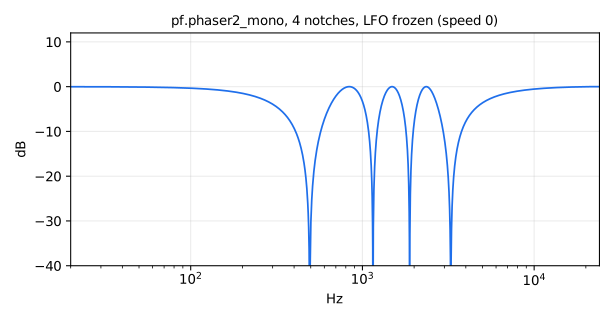
Mono phasing effect.
Usage
_ : phaser2_mono(Notches,phase,width,frqmin,fratio,frqmax,speed,depth,fb,invert) : _
Where:
Notches: number of spectral notches (MACRO ARGUMENT - not a signal)phase: phase of the oscillator (0-1)width: approximate width of spectral notches in Hzfrqmin: approximate minimum frequency of first spectral notch in Hzfratio: ratio of adjacent notch frequenciesfrqmax: approximate maximum frequency of first spectral notch in Hzspeed: LFO frequency in Hz (rate of periodic notch sweep cycles)depth: effect strength between 0 and 1 (1 typical) (aka "intensity") when depth=2, "vibrato mode" is obtained (pure allpass chain)fb: feedback gain between -1 and 1 (0 typical)invert: 0 for normal, 1 to invert sign of flanging sum
Test
pf = library("phaflangers.lib");
os = library("oscillators.lib");
phaser2_mono_test = os.tosc(330) : pf.phaser2_mono(4, 0.0, 50, 200, 1.5, 4000, 0.5, 0.8, 0.2, 0);
phaser2_mono_slider_test = os.tosc(330) : pf.phaser2_mono(4, hslider("phaser2_mono:phase01", 0, 0, 1, 0.01), hslider("phaser2_mono:width", 50, 10, 5000, 1), hslider("phaser2_mono:frqmin", 200, 20, 5000, 1), hslider("phaser2_mono:fratio", 1.5, 1, 4, 0.01), hslider("phaser2_mono:frqmax", 4000, 20, 10000, 1), hslider("phaser2_mono:speed", 0.5, 0, 10, 0.01), hslider("phaser2_mono:depth", 0.8, 0, 2, 0.01), hslider("phaser2_mono:fb", 0.2, -0.99, 0.99, 0.01), 0);
phaser2_mono_low_test = os.tosc(30) : pf.phaser2_mono(4, 0, 20, 20, 1.5, 20, 0, 1, 0, 0);
References
- https://ccrma.stanford.edu/~jos/pasp/Phasing.html
- http://www.geofex.com/Article_Folders/phasers/phase.html
- 'An Allpass Approach to Digital Phasing and Flanging', Julius O. Smith III, Proc. Int. Computer Music Conf. (ICMC-84), pp. 103-109, Paris, 1984.
- CCRMA Tech. Report STAN-M-21: https://ccrma.stanford.edu/STANM/stanms/stanm21/
(pf.)phaser2_stereo
Stereo phasing effect.
phaser2_stereo is a standard Faust function.
Usage
_,_ : phaser2_stereo(Notches,width,frqmin,fratio,frqmax,speed,depth,fb,invert) : _,_
Where:
Notches: number of spectral notches (MACRO ARGUMENT - not a signal)width: approximate width of spectral notches in Hzfrqmin: approximate minimum frequency of first spectral notch in Hzfratio: ratio of adjacent notch frequenciesfrqmax: approximate maximum frequency of first spectral notch in Hzspeed: LFO frequency in Hz (rate of periodic notch sweep cycles)depth: effect strength between 0 and 1 (1 typical) (aka "intensity") when depth=2, "vibrato mode" is obtained (pure allpass chain)fb: feedback gain between -1 and 1 (0 typical)invert: 0 for normal, 1 to invert sign of flanging sum
Test
pf = library("phaflangers.lib");
os = library("oscillators.lib");
phaser2_stereo_test = os.tosc(220), os.tosc(330) : pf.phaser2_stereo(4, 50, 200, 1.5, 4000, 0.5, 0.8, 0.2, 0);
References
- https://ccrma.stanford.edu/~jos/pasp/Phasing.html
- http://www.geofex.com/Article_Folders/phasers/phase.html
- 'An Allpass Approach to Digital Phasing and Flanging', Julius O. Smith III, Proc. Int. Computer Music Conf. (ICMC-84), pp. 103-109, Paris, 1984.
- CCRMA Tech. Report STAN-M-21: https://ccrma.stanford.edu/STANM/stanms/stanm21/